Phi Long is deeply attuned to representations and interventions of site. Initially trained in interior design, he emphasizes that site plays a crucial role in shaping the audience’s experience of a photograph or installation. These objects, in turn, serve as keys to challenging conventional assumptions about the site or unlocking discourses and social issues pertinent to it. One such issue of particular concern to him is the impact of human waste on the land. Thus, his project at The Factory Contemporary Arts Centre (The Factory), “The Prolonged Interventions” explores both Phi Long’s fascination with site and his preoccupation with the overwhelming presence of waste in urban and rural environments alike.
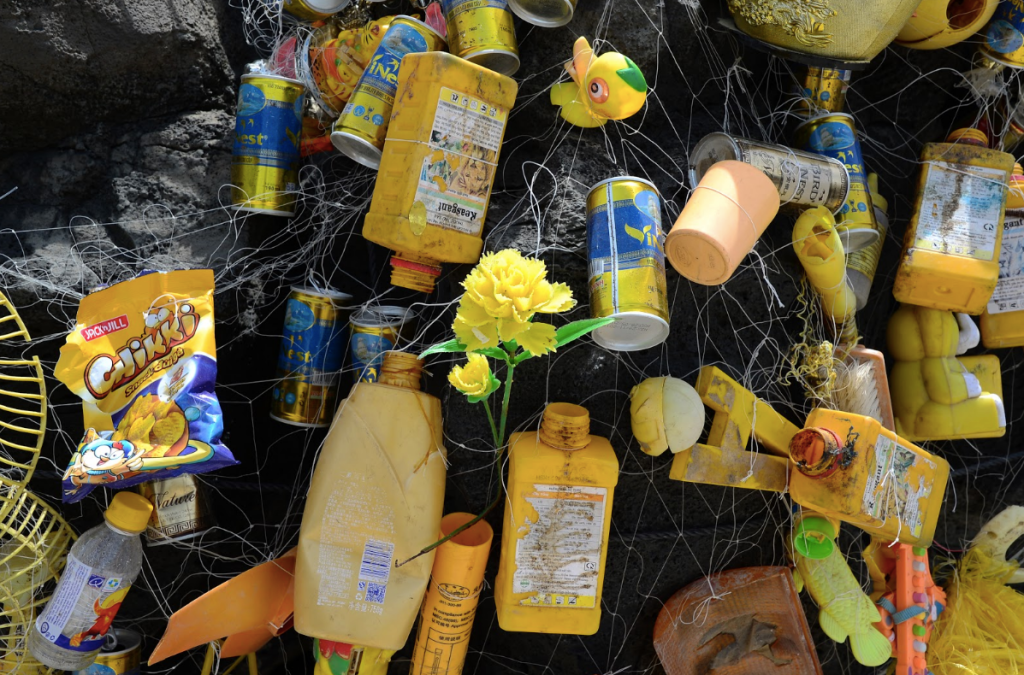
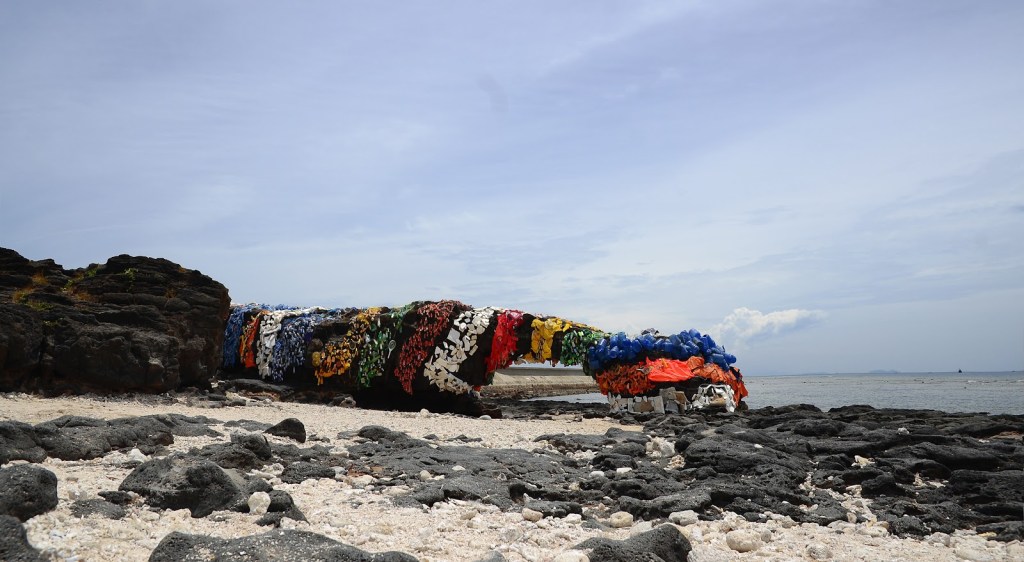
The photographic series Hidden Future documents a site-specific project Lê produced as part of a larger environmental initiative called “Clean Up the Beach”, organized by OpenM Corp*. Situated on Lý Sơn Island, an increasingly popular travel destination in Quảng Ngãi Province, Vietnam, the creation of these photographs was a collaborative effort between Lê and 79 volunteers. Together, they collected garbage from around the island, sorted it by size, shape, and color, and stitched the pieces together with rope to create “trash” nets. These nets were then wrapped around Tò Vò Gate, Lý Sơn’s iconic limestone archway formed by volcanic lava and shaped by sea waves over millions of years. In some photographs, the camera angle mimics the snapshots tourists typically take while standing beneath Tò Vò Gate. However, in Phi Long’s imagery, the brightly colored net consuming this local icon disrupts the popular scenic view, shedding light on the hidden issue of a natural landmark suffocated by artificial garbage left behind by locals and tourists. Through “Hidden Future”, Phi Long juxtaposes the natural wonder of Lý Sơn with the detritus of human life, raising questions about the ecological repercussions of modern consumer behavior.
The video documentary “Hidden Future”, directed by Phi Long and commissioned by Madeleine Cao, chronicles the efforts of the volunteers in cleaning the island, supporting Lê’s site-specific project at Tò Vò Gate, and organizing waste management and environmental education workshops for the local community.
“Invasive Deviant” is an installation at The Factory. A mountain of inorganic garbage flows through the entrance, inundates the interior gallery, and engulfs the furniture** within the space, blurring the boundaries between furniture and trash, between the “usable” and the “unusable.” Here, Phi Long questions the definition of “trash” and the lifecycle of objects in a consumerist urban society. In a culture that encourages constant consumption rather than repair, objects become “garbage” at an accelerated rate. Phi Long invites the audience to examine this relationship between garbage production and excessive consumption as they interact with the installation and to think critically about the impact of consumerism and a market-driven economy.
Lê’s works in “The Prolonged Interventions” continue the tradition of site-specificity*** in the visual arts, a practice that emerged in the United States and Europe in the 1970s. Site-specific art refers to works created in response to a specific location, born from artists’ critiques of museums as institutions that impose rules on artists and viewers, and of the “modernist artwork” as transportable, commodified, and confined to “white cube” spaces. Artists shifted their focus to the context of a site, exploring its history, topography, and discourse to create works deeply rooted in and responsive to the site’s unique circumstances. Notable examples include Doris Salcedo’s “Noviembre 6 y 7” (2002), an installation of chairs on the walls of the Palace of Justice in Bogotá, Colombia; Kara Walker’s massive sugar-clad sculpture A Subtlety (2014) in Brooklyn’s Domino Sugar Factory; and Ibrahim Mahama’s “Untitled” series (2013), public installations using jute sacks to cover market buildings in Accra, Ghana.
In Vietnam, site-specific art is relatively new, gaining prominence through artists like Trần Lương, whose performances in “Mạo Khê Coal Mine Project” (2001–2014) critiqued coal production sites in Northern Vietnam, and the Zenei Gang of Five, whose installation “Book Grave” (2008) lamented the decline of literary knowledge in remote Buddhist temples. More recently, the Art Labor Collective’s project “The Adventure of Color Wheel” (2014) redesigned the Pediatrics Department of the HCMC Eye Hospital using patterns inspired by child inpatients, addressing the healing power of art and creativity in healthcare.
Lê Phi Long contributes to this growing experimental discourse with his artistic practice, which has engaged with the specific histories of sites in Huế (his hometown), the Red River in Hanoi, and the Yamingshan area in Taipei, Taiwan. Through his photographs, installations, and performances, Lê seeks to initiate conversations—without being didactic—about the impact of human lifestyles on the environment and to propose solutions that organically reconnect humanity with nature. The title of this project, “The Prolonged Interventions,” reflects the artist’s desire to extend and sustain the urgently needed dialogue about humanity’s relationship with nature, the problem of waste, and its impact on daily life and the environment. By creating a space that compels ethical reflection, Lê challenges us to confront the damage we have caused to our planet.
Lê Phi Long extends his gratitude to The Factory, Madeleine Cao, and all the volunteers who contributed to this educational display.
NOTE:
* Clean Up the Beach is a waste management volunteer project, initiated by Madeleine Cao. Lê was invited to conduct a site-specific work using trash in Lý Sơn Island from 17-28/7/2016, to deliver a visual message about the situation of ineffective waste management on the island.
** The furniture is donated by the community, and installed by Lê in The Factory as part of the work.
*** The concept was refined and promoted by Californian modern art designer Robert Irwin, and officially declared as a contemporary art movement by architectural critic Catherine Howett in 1977.
SPECIAL THANKS TO:
The Factory Contemporary Arts Centre, Open M Corp
Curator: Le Thien Bao
Art Consultant: Curator Zoe Butt
Ly Son’s Project Lead : Cao Huyen Dieu Huong
79 volunteers from Ly Son Work Camp Team, The Factory Team
Curatorial Text & Translator : Hung Manh Duong
Project Assistant : Trinh Ngô (De Haira)
Cameraman and Photographers : Tan Phat Bui, Nhi Dang, Phuong Nguyen, Dat Nguyen
Film Editor : Truong Minh Quy

 Phi Long Le